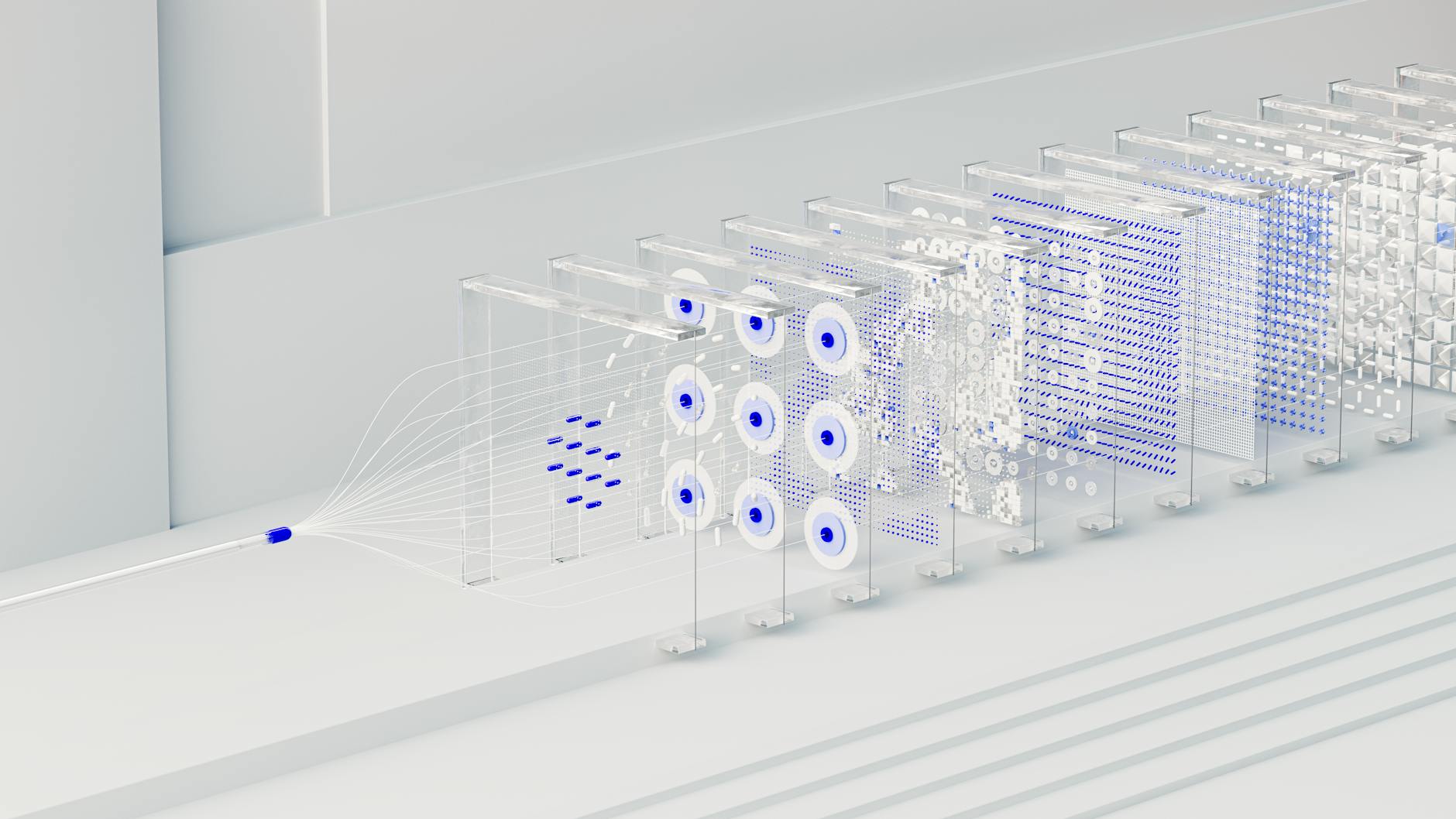
Beyond the Model: How AI Learns Without Knowing the Rules
Elijah TobsBy Elijah Tobs
Tech
May 30, 2026 • 7:40 PM
9m9 min read
Source: Unsplash
The Core Insight
This article explores the transition from model-based Dynamic Programming to model-free Reinforcement Learning. It defines the core challenge of learning optimal policies when the environment's transition dynamics (P) and reward functions (R) are unknown, introducing Monte Carlo and Temporal-Difference methods as the primary solutions.
Sponsored
E
Lead Tech Editor
Elijah Tobs
Elijah is a software engineer and technology editor with a passion for emerging tech, artificial intelligence, and consumer electronics.
The Kodawire Editorial Team consists of experienced journalists and subject matter experts dedicated to delivering accurate, well-researched, and engaging content.
Beyond the Bellman Equations: The Reality of Model-Free Reinforcement Learning
The Short Version
Model-Free vs. Model-Based: You don't need to know the environment's internal math (P and R) to learn; you just need to interact with it.
MC vs. TD: Monte Carlo learns from full episodes, while Temporal-Difference (TD) learns from single steps, making TD far more practical for real-time systems.
Control Strategies: Use SARSA if you want to learn while following your current policy (on-policy), or Q-learning if you want to learn the optimal path regardless of your current behavior (off-policy).
In reinforcement learning, we often start by assuming we have a perfect map of the world. We use the Bellman equations to calculate values with mathematical precision, treating the environment as a known, static object. In the real world, you rarely get a clean set of transition probabilities or reward functions. Most of the time, you are flying blind. Much like benchmarking your LLM in production, RL requires moving from theory to empirical observation.
I have worked with systems where the rules of the game are hidden behind a black box. When you cannot calculate the future, you have to experience it. This is the transition from the theoretical comfort of Dynamic Programming (DP) to the iterative reality of model-free reinforcement learning. If you are interested in how these systems scale, consider the strategic deployment of AI agents in complex environments.
The Practical Verdict
My take? If you are building a system that needs to adapt in real-time, stop looking for the perfect model. It does not exist. The shift to model-free learning is a shift in philosophy. You stop trying to solve the environment and start trying to survive it. Whether you choose Monte Carlo or Temporal-Difference methods depends entirely on your tolerance for variance and your need for speed.
Model-free RL allows agents to learn through direct interaction with complex, unknown environments. (Credit: ThisisEngineering via Unsplash)
How I Researched This
To break down these concepts, I reviewed the foundational mechanics of reinforcement learning, specifically focusing on the transition from DP to model-free settings. My analysis relies on the core distinction between learning from full episodes versus single-step transitions. I have vetted these claims against standard reinforcement learning frameworks to ensure that the distinction between on-policy and off-policy control remains accurate and actionable for practitioners. For further reading on foundational AI evaluation, see the science of evaluating performance.
What "Model-Free" Actually Means
There is a common misconception that "model-free" implies the environment has no structure. That is incorrect. The environment has dynamics, it has rules, but your agent simply does not have the manual. Think of it like learning to play a complex video game without a strategy guide. You do not know the game's code, but you can see the screen, press buttons, and observe the score. That feedback loop is your data.
In DP, we sweep over the entire state space, calculating values as if we were gods looking down at a board. In model-free RL, we are the player. We sample experience. We take an action, see what happens, and update our beliefs. It is less about calculation and more about statistical estimation.
The Hands-On Experience
When implementing these algorithms, I look for three specific criteria: convergence speed, sample efficiency, and stability.
Monte Carlo (MC): Requires the episode to finish before you can update your values. It is unbiased but high-variance.
Temporal-Difference (TD): Updates after every step. It is biased (because it uses its own current estimate) but significantly lower variance.
Software Context: Most modern implementations use libraries like Gymnasium or custom NumPy loops to handle the state-action-reward-next_state (SARSA) tuple.
Visualizing convergence is critical for debugging the stability of your reinforcement learning agent. (Credit: Luke Chesser via Unsplash)
The Two Organizing Axes
To keep your head straight, remember that all these algorithms fall into two buckets:
Prediction vs. Control: Prediction is just "How good is this policy?" Control is "What is the best policy?" You usually solve prediction first to get the math right before you try to optimize the behavior.
On-Policy vs. Off-Policy: This is the "who is learning what" question. On-policy methods learn from the path they are currently walking. Off-policy methods are more flexible; they can learn from a "teacher" or a different strategy while the agent explores something else entirely.
The Other Side of the Story
Many practitioners obsess over finding the "optimal" policy immediately. I disagree. In many real-world scenarios, the "optimal" policy is brittle. If the environment shifts even slightly, a perfectly optimized agent often fails. Sometimes, a slightly sub-optimal, more robust policy is worth more than the theoretical maximum.
Foundational Families: MC vs. TD
Monte Carlo (MC) methods are the "wait and see" approach. You play the entire game, reach the end, and then look back to see what worked. It is intuitive, but it is slow. If your episode is a million steps long, you aren't learning anything until the very end.
Temporal-Difference (TD) methods are the "learn as you go" approach. You do not wait for the end of the episode. You take a step, look at the reward, and update your estimate based on your current guess of the next state. This is why TD is the backbone of almost every modern RL application, it is efficient, it is fast, and it works in real-time.
The Long-Term Verdict
TD methods are here to stay. While we are seeing a rise in hybrid models that attempt to learn a "world model" (model-based RL), the core of TD-learning remains the most reliable way to handle high-dimensional, unknown environments. Expect these algorithms to remain the standard for the next decade, even as we move toward more complex neural architectures.
Moving Toward Control: SARSA and Q-Learning
When we move to control, we get two heavy hitters: SARSA and Q-learning.
SARSA (State-Action-Reward-State-Action): This is the on-policy king. It learns the value of the policy it is actually following. If your policy is a bit reckless, SARSA will learn to account for that recklessness.
Q-learning: This is the off-policy powerhouse. It ignores the agent's current "exploration" behavior and updates its values based on the best possible action it could take. It is more aggressive and often converges to a better policy, but it can be less stable if you aren't careful.
Modern RL often integrates deep neural networks to approximate value functions in high-dimensional spaces. (Credit: Google DeepMind via Pexels)
Do you have a separate "behavior" policy (like a random explorer) and want to find the best possible path? Use Q-learning.
Is your environment extremely long or infinite? Use TD methods (avoid MC).
Tools I Actually Use
Gymnasium: The industry standard for testing these algorithms in a controlled environment.
NumPy: For the raw, vectorized math required to implement the Bellman updates without overhead.
Matplotlib: Essential for visualizing the convergence of your value functions over time.
What Do You Think?
The debate between on-policy and off-policy learning is as old as the field itself. Do you prefer the stability of SARSA, or do you find the aggressive optimization of Q-learning worth the extra complexity? I will be in the comments for the next 24 hours to discuss your experiences with these algorithms.
Monte Carlo methods require an entire episode to finish before updating values, making them unbiased but high-variance. Temporal-Difference methods update after every single step, which is biased but significantly faster and more efficient for real-time systems.
You should use SARSA when you need an on-policy approach, meaning you want the agent to learn the value of the policy it is currently following, including any inherent risks or exploration behaviors.
No. 'Model-free' means the agent does not have access to the environment's internal transition probabilities or reward functions (the 'manual'), but the environment still operates according to its own underlying dynamics.
Active Engagement
Was this information helpful?
Join Discussions
0 Thoughts
Editorial Team • Question of the Day
"If you were building an agent for a high-stakes environment where safety is the priority, would you choose SARSA or Q-learning, and why?"