

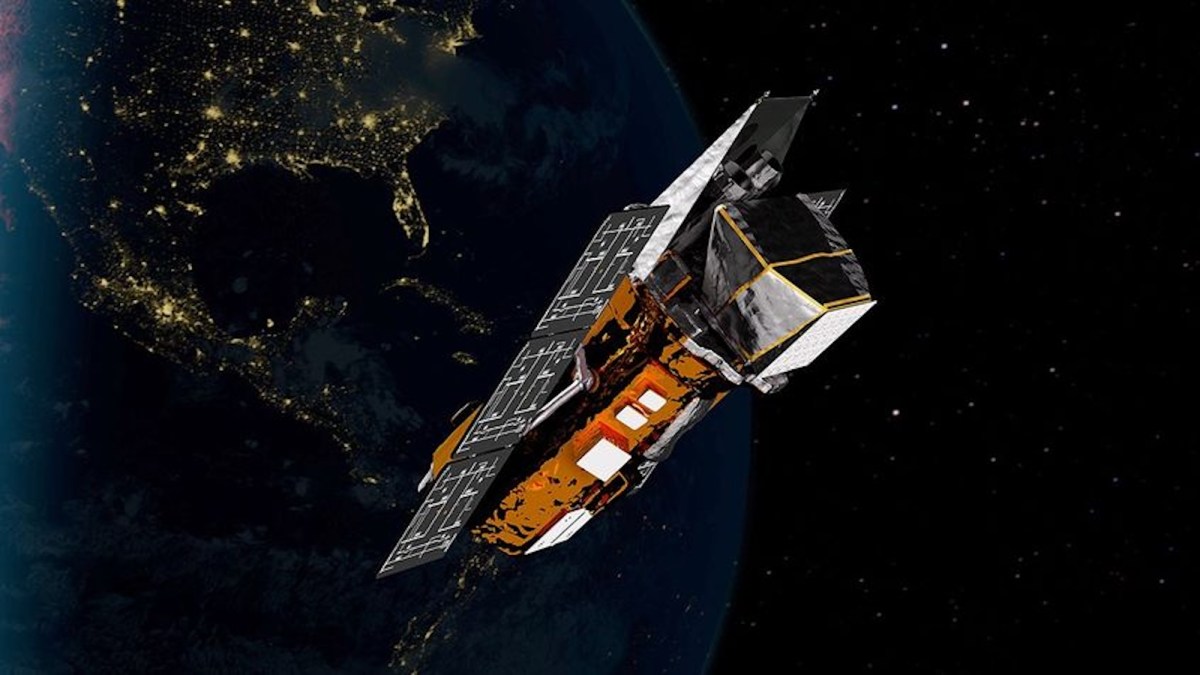
A NASA telescope will likely plummet to Earth on Wednesday
Coverage across the spectrum
How we rate outletsThe story so far
- NASA’s Swift Observatory to Re-Enter Atmosphere.
Who's reporting it
Timeline
Oct 31
Boston Herald: NASA telescope expected to plummet to Earth
3h ago
NASA Breaking News (XX): NASA’s Neil Gehrels Swift Observatory is expected to re-enter Earth’s atmosphere on Wednesday, Nov. 4, almost 22 years after launch. At laun
Latest stories

Taurids, Leonids and a Beaver Supermoon: Astronomical events for November 2026 - Gulf Coast News and Weather
Multiple outlets • 1h ago
This year’s November skies have plenty to offer for anyone who looks up, as there will be three meteor showers this month visible across the United States. But the showers are not the only thing to be excited about: a new comet study challenges theories about the origin of ancient life. On Mars, the Perseverance rover studies ancient water and the effects of dust that future astronauts may face. Meteor Showers: The Southern Taurids, Northern Taurids; Leonids According to the American Meteor Society, the Southern Taurids meteor shower will be visible and radiating from the constellation Taurus on the nights of Nov. 4 and 5, and the Northern Taurids will be observable on Nov. 11 and 12. Both nights feature about five meteors per hour, but are known for fireballs, or unusually bright meteors. With the moon only 22% illuminated for the Southern Taurids and 5% for the Northern Taurids, skies should be dark, if the weather allows, according to the American Meteor Society. According to EarthSky, the Leonids can be seen radiating from the constellation Leo in the east on the night of Nov. 17 and 18. Because the first-quarter moon sets around midnight, the Leonids will be best seen after it sets, and will feature 10 to 15 meteors per hour. The Leonids are known to be the fastest of the major meteor showers, according to Sterngucker. The Leonids are famous for occasional meteor storms, in which thousands can be seen every hour. On Nov. 17, 1966, rates reached around 40 to 50 per second for about 15 minutes, according to EarthSky. Storms sometimes recur every 33 to 34 years, but none are expected this year. How to Watch the Showers While meteor-watching does not need binoculars or a telescope, there are a few other ways to improve the watching experience. Dark skies show a lot more meteors, so it’s best to go somewhere with low light pollution. Lake Hudson Recreation Area, which is about an hour from Albion, has a designated dark sky preserve that is open 24 hours a day, according to the Michigan Department of Natural Resources. It is best to let your eyes adjust to the darkness for about 20 minutes for optimal night vision, and avoid staring at one constellation. According to Star Walk, meteors that are farther from their radiant, the point they appear to come from, have longer tails that are easier to spot. Viewers should be sure to dress warmly, as it can get chilly this time of year in Michigan. Comets: Space Visitors on the Move When it comes to recent developments about comets, researchers at the University of Cambridge used advanced computer simulations to find that ancient comets striking early Earth were unlikely to deliver intact prebiotic (pre-life) molecules, like hydrogen cyanide (HCN). This challenges the “long-standing” hypothesis that comets seeded Earth with the molecules necessary for life. Researchers used computer simulations and found that comets strike Earth too fast and at too steep an angle for the organics to survive. Even if enough HCN could survive the impact, the amount needed would be very rare. In the study published, Richard Anslow, the study’s lead author at Cambridge’s Institute of Astronomy, said, “It’s kind of a romantic idea, but our results suggest it’s highly unlikely.” Researchers suggested the possibility that asteroid impacts or Earth’s own chemistry could have created the necessary molecules instead. Recent Discoveries on Mars NASA's Perseverance rover, which landed on Mars in the Jezero Crater in 2021 with aims of studying the habitability of ancient Mars, continues its exploration of the Crater, using laser data from its SuperCam instrument to rework scientists' understanding of the crater. Scientists expected to find sedimentary layers, but instead found igneous rocks, which form from magma or volcanic activity, according to NASA. Using the data, researchers found three distinct periods of time when water was present in the crater, according to a study published Sept. 21 in “Communications Earth & Environment.” The first era was carbonate from carbon dioxide-rich groundwater. The second was a lake-like event that left behind silica deposits, and the third was a thermal event that pushed heated groundwater, which formed veins of calcium sulfate and fluorite. This finding is important because water reacting with olivine, a volcanic mineral, can release hydrogen, a possible food source for microbes. It can also leave behind carbonate and silica, which can preserve ancient traces of microbes, NASA said. However, the study does not report evidence of life. Additionally, Perseverance has been studying ultrafine dust particles on Mars about 100 nanometers wide, which is hundreds of times thinner than a human hair. Over the course of 1,645 Martian days, the rover measured dust settling on samples of material it carries, including spacesuit material, according to NASA. Dust poses problems for human space exploration. During the Apollo missions, lunar dust scratched visors and wore down layers on spacesuits, leading some astronauts to report symptoms similar to hay fever, NASA said. While Martian dust is typically less abrasive than lunar dust, “some particles are small enough to be inhaled and enter the bloodstream,” the agency said. The findings, published Oct. 27 in the “Proceedings of the National Academy of Sciences,” “could inform spacesuit and habitat design, dust-removal procedures and crew health standards for future crewed missions,” NASA said.
3 sources

Families of Florida Learjet crash victims pay tribute as investigators say plane may have broken up in the air
Multiple outlets • 57m ago
WEST PALM BEACH, Fla. — Parts of a business jet likely started to break off even before it slammed into the ground and erupted in a ball of flames in South Florida, killing all nine people on board, a federal investigator said Monday. Video recorded by passersby captured the Bahamas-bound Learjet’s rapid nosedive Sunday afternoon before it exploded in Greenacres, about 7 miles (11 kilometers) southwest of West Palm Beach. Flames flickered around chunks of pavement lining the crater as shocked…
15 sources

'Absurd Rhetoric': North Korea Slams FBI's Binance Hack Allegations As 'Grave' Provocation
Multiple outlets • 1h ago
North Korea on Tuesday dismissed US allegations that it was behind a $6 billion cryptocurrency theft from Binance as "absurd rhetoric", accusing Washington of seeking to portray the country as a cybercriminal…
5 sources

Queen Camilla admits global scale of violence against women and girls is 'terrifying'
Multiple outlets • 1h ago
Queen Camilla warned the true scale of violence against women and girls was 'terrifying' as she urged the world to listen to victims and support them when they seek…
4 sources

Andy Burnham to outline debt cost support plans for Commonwealth countries at summit with King Charles
Multiple outlets • 1h ago
It comes as the Prime Minister, who flew into the Commonwealth Heads of Government summit in Antigua and Barbuda, faces a row over reparations for Britain's role in the transatlantic slave…
3 sources

Texas couples, 2 young children, caregiver and pilots killed in Florida Learjet crash
Multiple outlets • 2h ago
A Learjet that crashed into a Florida roadway on Sunday, killing all nine people aboard, may have been breaking up before it made impact with the ground, the NTSB said.
3 sources
Reader Discussion
Loading comments…