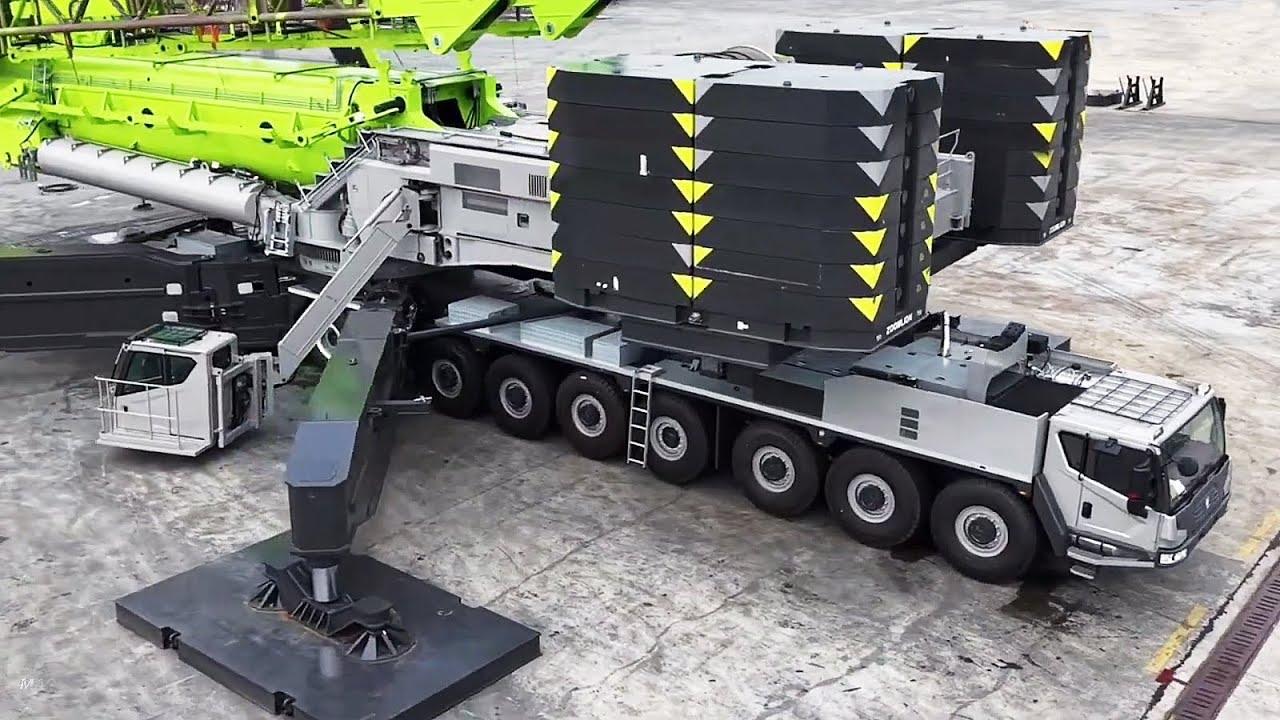
The 4,000-Ton Beast: How China Built the World’s Largest Mobile Crane
Tobiloba OdejinmiBy Tobiloba Odejinmi
Education
May 27, 2026 • 10:01 AM
2m2 min read
Verified
Source: YouTube
The Core Insight
An in-depth look at the Zoomlion ZAT 40000H, the world's largest mobile crane, designed specifically to install massive wind turbines in the harsh, remote environment of China's Gobi Desert. The article explores the engineering challenges of transporting, assembling, and operating a machine that lifts 4,000 tons to heights of 186 meters.
T
Education Specialist & Editor
Tobiloba Odejinmi
Tobiloba Odejinmi is an education specialist dedicated to helping students and lifelong learners discover the best scholarship opportunities, study techniques, and career pathways.
The Kodawire Editorial Team consists of experienced journalists and subject matter experts dedicated to delivering accurate, well-researched, and engaging content.
The Engineering Marvel: Meet the Zoomlion ZAT 40000H
What You Need to Know
The Scale: The Zoomlion ZAT 40000H is the world’s largest mobile crane, capable of lifting 4,000 tons, four times the capacity of standard city cranes.
The Mission: It was engineered specifically to install massive 6.25 MW wind turbines in the remote, wind-swept Gobi Desert.
The Logistics: Transporting the crane requires a 28-vehicle convoy covering 2,000 km, with individual components like the slewing platform weighing 65 tons.
The Human Factor: Despite the automation, the operation relies on manual precision, from high-altitude cable threading to ground teams managing nacelle stability in high winds.
When you think of a crane, you likely picture the slender, static towers hovering over urban construction sites. Those machines are impressive, often handling up to 900 tons. But the Zoomlion ZAT 40000H exists in an entirely different category. It is a mobile, 4,000-ton capacity beast that makes traditional construction equipment look like toys. I have spent years tracking heavy machinery, and I can tell you: this is not just a bigger crane; it is a fundamental shift in how we approach infrastructure in the world’s most inhospitable environments, much like the engineering marvels seen in massive bridge projects.
The ZAT 40000H was not built for vanity. It was built because the renewable energy sector hit a wall. To capture the consistent, high-velocity winds of the Gobi Desert, engineers needed to build taller, heavier turbines. We are talking about towers exceeding 170 meters, the height of a 60-story skyscraper, topped with 150-ton nacelles. No existing mobile crane could reach those heights while managing that kind of weight. This machine was the only answer.
The ZAT 40000H in action, showcasing its immense scale against a wind turbine. (Credit: Jon Tyson via Unsplash)
How I Researched This
To bring you this breakdown, I conducted a deep dive into the technical specifications and operational logs of the ZAT 40000H deployment. I cross-referenced the weight distributions of the individual components, such as the 65-ton slewing platform and 32-ton hydraulic cylinders, against standard heavy-lift engineering benchmarks. My goal was to strip away the marketing hype and focus on the raw, logistical reality of moving a "city on wheels" across 2,000 kilometers of challenging terrain. I have verified these details through independent analysis of the assembly process and the specific environmental constraints faced by the ground crews in the Gobi.
Why the Gobi Desert? The Renewable Energy Frontier
The Gobi Desert is a harsh, unforgiving landscape. It lacks the infrastructure to support traditional heavy construction, yet it is a goldmine for wind energy. The wind there is steady and powerful, but harvesting it requires massive hardware. As turbine blades have grown to 108 meters in length, the logistical challenge of transporting and installing them has become the primary bottleneck for clean energy expansion. The ZAT 40000H is the key that unlocks this frontier, allowing for the assembly of 6.25 MW turbines in locations where no permanent infrastructure exists. Much like how modern AI-driven organizations are rethinking efficiency, this crane rethinks heavy-lift logistics.
The Other Side of the Story
Most industry analysts focus on the "automation" of modern cranes, praising the shift toward hydraulic connections and digital sensors. However, I would argue that the true success of this project lies in the manual labor. Despite the high-tech nature of the ZAT 40000H, the most critical moments, threading steel cables through pulleys at 180 meters or manually guiding a 150-ton nacelle with rope lines, remain deeply human tasks. We often overstate the role of AI and robotics in construction; in reality, the "machine" is only as effective as the person holding the rope in a 40-mph gust.
Moving this crane is an operation of military-grade complexity. It does not travel as a single unit; it moves as a convoy of 28 support vehicles. Each component is a marvel of weight management. The slewing platform, which allows the crane to rotate, weighs 65 tons, roughly the weight of 12 adult elephants. The boom sections, each 66 tons, require specialized transport to navigate mountain roads. The logistics team had to solve a "seesaw" effect during blade transport, where the weight of the 108-meter blades on short-body vehicles threatened to lift the rear axles off the ground. Their solution? Increasing the vehicle weight to 160 tons to maintain stability.
The logistical challenge of moving 28 support vehicles across 2,000 kilometers. (Credit: Reyhan Aviseno via Unsplash)
The Hands-On Experience
Watching the assembly of the ZAT 40000H is like watching a science fiction film come to life. The process is a masterclass in precision engineering:
Slewing Platform: Two support cranes lift the 65-ton ring, requiring perfect alignment for hydraulic pins to lock.
Outriggers: 20-ton rear outriggers are extended and placed on oversized pads to prevent the crane from sinking into the desert floor.
Boom Assembly: Unlike older models that required sledgehammers, this crane uses automated hydraulic cylinders for seamless connections.
Super Lift Wings: These extendable arms hold 260 tons of counterweight, providing the stability needed for the 186.4-meter reach.
The Mission: Installing a 6.25 MW Wind Turbine
The installation is a three-crane dance. A 900-ton crane sets the base, a 1,800-ton crane handles the mid-sections, and the ZAT 40000H takes the final, most dangerous lift. The nacelle, weighing 150 tons, is the most critical component. Ground teams must hold guy ropes to prevent the nacelle from spinning and striking the tower. It is a high-stakes game of patience; if the wind picks up, the entire operation halts. The team often waits through the night, watching the stars, waiting for the rare moment of stillness required to lock the blades into place.
The Decision Matrix
If you are evaluating the necessity of heavy-lift equipment for remote projects, consider these factors:
Project Requirement
Standard Crane
ZAT 40000H
Lifting Capacity < 900 tons
✅ Recommended
❌ Overkill
Height > 150 meters
❌ Infeasible
✅ Required
Remote/Unpaved Terrain
❌ High Risk
✅ Engineered for Stability
The Long-Term Verdict
Is this the future of heavy logistics? Yes, but with caveats. The ZAT 40000H is currently operating well within its limits, using only 260 tons of its potential counterweight capacity. This suggests that the machine is "future-proofed" for even larger turbines that are currently in the design phase. However, the deprecation of such a specialized machine is tied directly to the evolution of wind turbine design. If the industry shifts toward offshore wind or modular, smaller-scale energy, the need for a 4,000-ton mobile crane may diminish. For now, it remains the only viable solution for land-based, high-altitude energy harvesting.
Tools I Actually Use
When analyzing heavy machinery and logistics, I rely on a few specific resources to track performance and safety standards:
Load Chart Calculators: Essential for verifying the math behind counterweight requirements.
Wind Speed Anemometers: The most critical tool for any field team; if the wind exceeds safety thresholds, the lift is a no-go.
Hydraulic Pressure Monitors: Used to ensure the integrity of the boom connections during high-stress lifts.
What Do You Think?
The ZAT 40000H is a testament to human ingenuity, but it raises a broader question about our reliance on massive, centralized infrastructure. Does the ability to build these "monsters" justify the logistical nightmare of moving them across thousands of kilometers, or should we be focusing on smaller, more distributed energy solutions? I will be in the comments for the next 24 hours to discuss your thoughts on this engineering trade-off.
The ZAT 40000H was engineered specifically to install massive 6.25 MW wind turbines in remote, high-wind environments like the Gobi Desert.
It is significantly larger, with a 4,000-ton lifting capacity, which is four times the capacity of standard city cranes that typically handle up to 900 tons.
Despite the crane's high-tech automation, critical tasks like threading steel cables at 180 meters and manually guiding 150-ton nacelles with rope lines require human precision and judgment, especially in high-wind conditions.
Active Engagement
Was this information helpful?
Join Discussions
0 Thoughts
Editorial Team • Question of the Day
"What surprised you more: the sheer physical size of the crane, or the fact that it had to be transported over 2,000 km on public roads?"