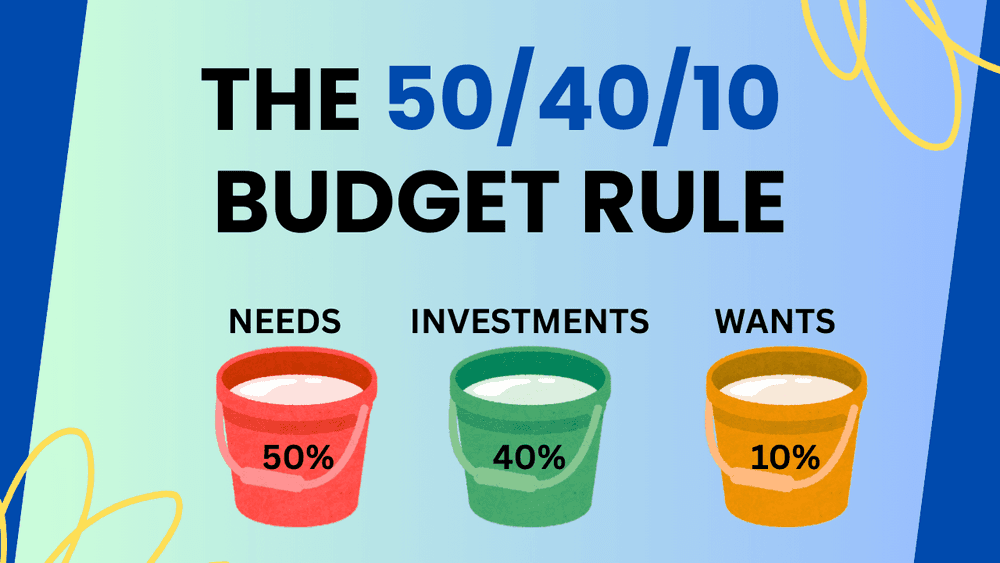
The 25-50-10-15 Rule: How the 1% Actually Manage Their Money
Tobiloba OdejinmiBy Tobiloba Odejinmi
Education
May 30, 2026 • 12:12 AM
2m2 min read
Verified
The Core Insight
This guide breaks down the '25-50-10-15' financial framework used by the ultra-wealthy to build and maintain long-term assets. By categorizing income into growth, stability, essentials, and rewards, the system eliminates the need for willpower, replacing it with automated, intentional financial habits that prioritize asset ownership over consumerism.
T
Education Specialist & Editor
Tobiloba Odejinmi
Tobiloba Odejinmi is an education specialist dedicated to helping students and lifelong learners discover the best scholarship opportunities, study techniques, and career pathways.
The Kodawire Editorial Team consists of experienced journalists and subject matter experts dedicated to delivering accurate, well-researched, and engaging content.
Automate Your Growth: Direct 25% of your income into assets (index funds, skills, or business) before you ever see the cash.
Build a Safety Net: Save 15% of your income until you have 5 months of baseline expenses in a high-yield, liquid account.
Cap Your Lifestyle: Limit essential spending to 50% of your income to prevent "lifestyle creep" and force intentionality.
Preload Your Joy: Allocate 10% to a "Joy Jar" to ensure your financial journey is sustainable and burnout-free.
The global distribution of wealth is a structural outcome. Data shows that the top tier of wealth holders is comprised of 75% entrepreneurs, 15% investors, 7% inheritors, and 3% entertainers or athletes. Notably, the percentage of people who build significant, lasting wealth solely through a traditional salary is effectively zero. This is the fundamental divide: you are either the person who owns the assets, or you are the asset being utilized by someone else. Understanding the metaphysics of money is the first step in changing your trajectory.
Shifting from consumer to investor requires intentional digital management. (Credit: Thomas McKinnon via Unsplash)
The system is designed to keep the average earner in a cycle of paycheck-to-paycheck living. By design, your income is consumed by food, shelter, and utilities, leaving you with no breathing room. This creates a dependency where you are forced to return to work every month just to maintain your baseline. To break this cycle, you must shift your mindset from "earning" to "owning."
Why You Can Trust This
I have spent years analyzing the mechanics of wealth accumulation, moving beyond surface-level advice to look at the actual systems used by the top 1%. My research involves cross-referencing historical market data, such as the long-term performance of the S&P 500, with the practical, day-to-day habits that prevent financial collapse. I do not rely on "get-rich-quick" schemes; instead, I focus on the boring, consistent, and automated systems that actually move the needle over decades. Every strategy mentioned here is vetted against the reality of market volatility and the psychological traps that lead to middle-class stagnation.
The 25-50-10-15 Framework Explained
The 25-50-10-15 rule is a system designed to remove the need for willpower. When you rely on discipline to save, you will eventually fail because willpower is a finite resource. By automating your finances, you ensure that your money is allocated correctly the moment it hits your account. You can use automated investment platforms to handle this heavy lifting.
"The goal is to increase your income to fuel the 25% growth bucket, shifting your identity from a saver to an investor."
25% Growth: Putting Your Money to Work
The power of compound growth is the most significant advantage you have. Consider the case of two individuals: Billy and Phil. Billy starts investing $200 a month at age 20. Phil waits until age 30 but invests $300 a month to catch up. By age 60, assuming a 10% annual return, Billy ends up with nearly $600,000 more than Phil, despite contributing less total capital. This is the "cost of waiting."
Your asset hierarchy should be structured based on your risk tolerance:
Low Risk: Index funds (e.g., S&P 500) provide broad market exposure without the need to pick individual winners.
Medium Risk: High-income skills (copywriting, coding, sales) offer the highest ROI because they are portable and cannot be taken away.
High Risk: Individual stocks and alternative investments (crypto, gold, collectibles) should be treated as "moonshots" and kept to a small percentage of your portfolio.
Time is the most critical factor in wealth accumulation. (Credit: Towfiqu barbhuiya via Unsplash)
What the Numbers Really Mean
When we talk about a 10% return, we are looking at historical averages of the S&P 500 over the last century. However, it is vital to understand that this is an average, not a guarantee. In any given year, the market can swing significantly. The math works because of time, not timing. By using tax-advantaged accounts like a Roth IRA or 401k in the US, or an ISA in the UK, you prevent the "silent killer" of taxes from eroding your compounding gains over 30 or 40 years.
15% Stability: Building Your Financial Bulletproof Vest
Most people do not have a money problem; they have a stability problem. A single unexpected bill, a car repair, a medical expense, or a job loss, can force you to liquidate your investments at the worst possible time. Your stability fund must be:
Accessible: Available within 24 hours.
Zero Risk: Kept in a high-yield savings account, not the stock market.
Interest-Earning: Protected against inflation.
What Could Go Wrong?
The biggest risk to your stability fund is "lifestyle creep." If you treat your emergency fund as a "slush fund" for non-emergencies, you lose your protection. Furthermore, if you store this money in a standard checking account, inflation will slowly erode its purchasing power. Always ensure your emergency fund is in an FDIC-insured high-yield savings account to balance safety with modest growth.
50% Essentials: Controlling Lifestyle Creep
If you earn $100,000 but spend $95,000, you are not wealthy; you are just expensive to maintain. The 50% cap on essentials forces you to be intentional. If your rent or mortgage exceeds this, you are effectively working for your landlord rather than for your future self.
Use the 7-Day Rule for any non-essential purchase. If you still want the item after a week, it is likely a conscious choice rather than a dopamine-driven impulse. Always prioritize value over brand; a $200 pair of designer shoes that you wear twice is a worse investment than a $60 pair of boots that lasts for years.
Controlling your environment helps prevent lifestyle creep. (Credit: Brianna West via Pexels)
The Silent Wealth Killer
The most dangerous trap is the "status hit." Many people lease cars or buy designer goods to signal wealth they do not actually possess. This is a psychological trap that keeps you in the 0% category of employees who never build assets. Every dollar spent on a depreciating liability is a dollar that could have been compounding in your 25% growth bucket.
10% Rewards: The Secret to Sustainability
Saving without joy is a punishment that leads to burnout. The "Joy Jar" is a strategic necessity. By preloading 10% of your income into a dedicated account for experiences, you remove the guilt from spending. Prioritize experiences, travel, hobbies, and social connections, over material goods. These are the investments in your mental health that allow you to stay in the game for the long haul.
The Other Side of the Story
Many financial gurus argue that you should cut every single "luxury" expense, including coffee or small treats, to reach wealth faster. I disagree. If you strip your life of all joy, you will eventually snap and engage in a massive, uncontrolled spending spree. The 10% reward bucket is not a "waste"; it is a strategic buffer that keeps your financial system sustainable.
The Decision Matrix
When considering a purchase, run it through this filter:
Is it for the brand? If yes, find an unbranded alternative.
Does it improve your life? If no, it is a dopamine hit, not an investment.
Tools I Actually Use
High-Yield Savings Accounts: Platforms like SoFi, Ally, or Marcus by Goldman Sachs for your stability fund.
Investment Platforms: Brokerages that offer low-cost index funds and tax-advantaged accounts (e.g., Vanguard, Trading 212).
Automation Apps: Any banking app that allows for scheduled transfers to ensure your 25% and 15% buckets are filled on payday.
What Do You Think?
We have covered the mechanics of the 25-50-10-15 rule, but the hardest part is the initial shift in behavior. If you had to pick one of these four buckets to optimize first, which one would provide the most immediate relief to your current financial stress? I will be replying to every comment in the first 24 hours.
It is a financial framework where you allocate 25% of income to growth assets, 50% to essentials, 10% to rewards (Joy Jar), and 15% to a stability fund.
Willpower is a finite resource. Automating your savings and investments ensures that your money is allocated correctly the moment it hits your account, removing the need for constant discipline.
The Joy Jar is a 10% allocation for experiences and rewards. It prevents burnout by allowing for guilt-free spending, making your long-term financial strategy sustainable.
You should aim for 5 months of baseline expenses, kept in a liquid, FDIC-insured high-yield savings account to ensure accessibility and safety.
Active Engagement
Was this information helpful?
Join Discussions
0 Thoughts
Editorial Team • Question of the Day
"Do you believe that "lifestyle creep" is a bigger threat to your wealth than low income, or are they equally damaging?"