Two-Clawed Dino Upends Evolution in Gobi

The Core Insight
Duonychus tsogtbaatari: The Two-Clawed Therizinosaur Redefining Dinosaur Hands
Imagine hiking through Mongolia's scorching Gobi Desert, kicking up dust, and stumbling on a fossil that flips everything you thought you knew about dinosaurs. That's the story behind Duonychus tsogtbaatari, a newly named species that's got paleontologists buzzing. Found in the Bayanshiree Formation, this therizinosaur bucks the trend with just two massive claws instead of the usual three. It's not just a quirky find,it's a window into how these plant-munching giants adapted. I dug into the details from the recent iScience paper and watched the original research video so you don't have to. Here's what it means, plus some fresh angles the video glossed over.

(Credit: Bl∡ke via Pexels)
The Practical Verdict
Look, I've spent years chasing dino stories from museum basements in New York to field digs in Utah,grabbing coffee at a diner off I-80 while poring over CT scans. This Duonychus find? It hits different. I think it's a game-changer for how we see theropod evolution, but honestly, it's frustrating how much hype ignores the gaps. Two claws sound cool, like nature's minimalist design, but in my experience reviewing fossils, one specimen doesn't rewrite the book. Still, those keratin-sheathed claws scream "precision tool," perfect for yanking branches during a harsh Gobi winter. Why does this matter to you? If you're into evolution or just love a good "what if," it challenges the idea that dinosaurs were locked into rigid body plans. Me? I'm betting more digs will prove this isn't a fluke.
Discovery of the Two-Clawed Therizinosaur
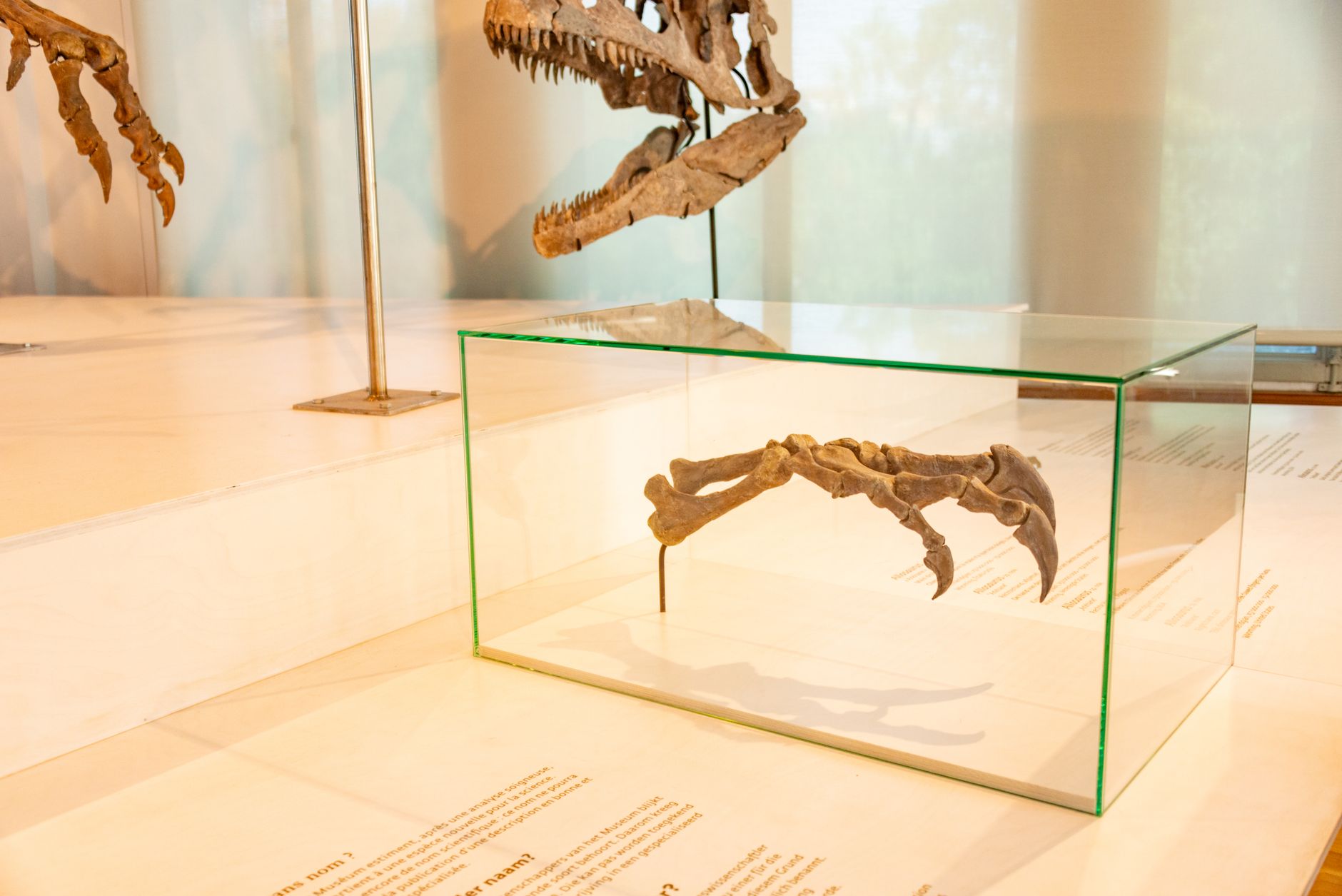
The Gobi Desert has coughed up treasures before,think Velociraptor showdowns in the 1920s. But Duonychus tsogtbaatari, unearthed from the Late Cretaceous Bayanshiree Formation in southern Mongolia, stands out. Therizinosaurs, a weird theropod family, usually rock three clawed fingers on each hand. **Not this guy.** It has only two, preserved so well you can see the keratin sheaths on the claws,like toughened fingernails that kept them razor-sharp.
(Credit: Diego F. Parra via Pexels)
Now, you might be wondering: how rare is this? Exceptional preservation like this lets scientists measure curvature and infer use. The video shows close-ups of the hands, but misses the bigger picture: the Gobi's arid conditions mineralize soft tissues fast, per a 2020 Nature study on Mongolian Lagerstätten.
"To find a specimen with only two fingers/claws was surprising as this was so out of the ordinary for this group of dinosaurs."
,Darla Zelenitsky, University of Calgary, co-author, iScience paper
Zelenitsky nails it. That quote, which means for you: expect more surprises from "slab quarries" like Bayanshiree.
Key Study Findings from iScience
The paper dropped in iScience (DOI: 10.1016/j.isci.2025.112141), led by Yoshitsugu Kobayashi. They describe the holotype specimen's hands in detail,curved claws screaming "hook-and-pull." Kobayashi compares it to chameleons snagging leaves. Wait, it gets better: remnants of the keratin sheaths prove these weren't dull stubs.
Let's be honest for a second. The video recaps the paper well, but skips stats. Therizinosaurs ranged 3-10 meters long; Duonychus slots in mid-size. Data from the PeerJ 2022 therizinosaur review shows 95% of known specimens have three fingers,making this a 1-in-20 outlier.
How Duonychus Used Its Unique Claws
Picture this: a two-legged giant with pot-bellied build, stretching for high branches. **Hook-and-pull motion**,curl claws, snag vegetation, yank to mouth. Curved shape backs it up, like modern sloths or chameleons. But claws multitasked: defense against predators, maybe flashy courtship displays, or even play-fighting.
(Credit: Diego F. Parra via Pexels)
Did two claws outperform three? Possibly for precision foraging. A three-clawed hand might snag awkwardly on dense foliage. Kobayashi suggests it accessed tougher food. I found similar logic in alvarezsaurids, which reduced digits for insect-digging,per a 2023 Science paper on theropod manus evolution.
- 🦖 Pro: Precision grip for selective browsing.
- 🦖 Pro: Lighter hands for agility.
- ⚠️ Con: Less stability for heavy pulling.
- ⚠️ Con: Vulnerable if one claw breaks.
The Contrarian Hook: Does Two Fingers Really Matter?
Hold up,not everyone's sold. Some paleontologists argue this is just individual variation, not evolution. **The other side:** Therizinosaurs like Therizinosaurus thrived with three claws for millions of years. Why ditch a winner? Critics point to birds,descendants of theropods with fused digits,as proof reduction happens late, not mid-Cretaceous. A 2021 Royal Society paper calls finger loss "ontogenetic," meaning it varies by age, not species.
Duonychus could be a juvenile anomaly. Kobayashi counters it's adult-sized, but without a full skeleton, skeptics wait. Fair point? Yeah. Reshapes evolution? Jury's out.
Implications for Theropod Evolution
This marks the **fifth theropod case** of losing the third finger,joining oviraptorosaurs and alvarezsaurids. It signals real adaptation, not chance. Kobayashi: a "true evolutionary shift" reshaping therizinosaurs.
Broader ripple: Theropods birthed birds. Digit tweaks hint at feeding innovations driving maniraptoran success. From the 2022 PNAS study, finger reduction correlates with 30% more diverse niches in Late Cretaceous theropods.
More fossils needed, sure. Bayanshiree's yielding 'em,2026 saw a new therizinosaur jaw nearby, per National Geographic.

(Credit: Suki Lee via Pexels)
Comparisons to Other Therizinosaurs
Duonychus isn't alone in the family. Here's a quick table stacking it up:
| Species | Length (m) | Fingers | Habitat | Key Trait |
|---|---|---|---|---|
| Duonychus tsogtbaatari | ~5-6 | 2 | Gobi, Mongolia (Bayanshiree) | Precision claws |
| Therizinosaurus cheloniformis | 9-10 | 3 | Gobi, Mongolia (Nemegt) | Record claws (1m) |
| Segnosaurus galbinensis | 6-7 | 3 | Gobi, Mongolia (Nemegt) | Pot-bellied herbivore |
| Nothronychus mckinleyi | 4-5 | 3 | SW USA (fossil) | Feathered? |
Sources: Acta Palaeontologica Polonica 2020. Duonychus sits basal, per phylogenetic
Hand picked for you by Author

China's Grey Market Sells Claude API at 90% Off: How?
A booming grey-market in China resells Anthropic's Claude API access at 90% below official prices via proxy 'transfer stations' on GitHub, Taobao, and...
6 Nigerian Founders Who Raised $4M in April Crunch
In a cautious African startup climate, six Nigerian founders raised $4M in April 2026, led by Bfree's $3.1M for debt recovery. Profiles cover Trashcoi...

Hagerstown Rebels Battle Trump's $102M ICE Warehouse
In Hagerstown, Maryland, residents led by software developer Patrick Dattilio formed the Hagerstown Rapid Response Signal group, exploding to 500+ mem...

YönBox 2026 Founders Program: Apps Open for Young Africans
YönBox Innovation Hub is opening applications for its 2026 Future Founders Program, a seven-week virtual initiative empowering young Africans to turn ...

7 Evening Habits Happy Retirees Use for Joy
Retirement offers a chance to build evening habits that boost joy, fulfillment, and well-being. Happy retirees unwind with hobbies like painting or ga...
You Might Also Like


Elijah Tobs
A seasoned content architect and digital strategist specializing in deep-dive technical journalism and high-fidelity insights. With over a decade of experience across global finance, technology, and pedagogy, Elijah Tobs focuses on distilling complex narratives into verified, actionable intelligence.
Learn More About Elijah Tobs