Win $50K: The 2026 GoGettaz Agripreneur Prize Guide for Founders
Elijah TobsBy Elijah Tobs
Education
May 26, 2026 • 6:33 PM
2m2 min read
Verified
The Core Insight
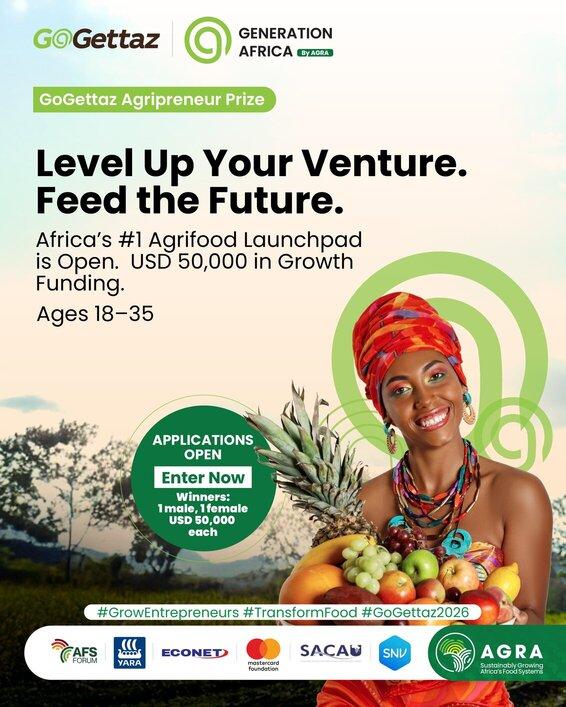
The 2026 GoGettaz Agripreneur Prize Competition offers a platform for young African entrepreneurs to secure up to $50,000 in funding and global visibility. Targeting innovators in the agrifood sector, the competition emphasizes impact-driven solutions in technology, nutrition, job creation, climate resilience, and gender equity.
As the founder and primary investigative voice at Kodawire, Elijah Tobs brings over 15 years of experience in dissecting complex geopolitical and financial systems. His work is centered on the ethical governance of emerging technologies, the shifting architectures of global finance, and the future of pedagogy in a digital-first world. A staunch advocate for high-fidelity journalism, he established Kodawire to be a sanctuary for deep-dive intelligence. Moving away from the ephemeral nature of modern headlines, Kodawire delivers permanent, verified insights that challenge the status quo and empower the global reader.
The 2026 GoGettaz Agripreneur Prize: Your Path to $50,000
For many entrepreneurs working within the African agrifood sector, the challenge is rarely a lack of vision; it is the scarcity of capital and the difficulty of gaining visibility on a continental stage. The 2026 GoGettaz Agripreneur Prize Competition is designed to bridge that gap. By offering not just significant financial backing but also a platform for mentorship and networking, this initiative aims to elevate the next generation of leaders who are actively reshaping how food is produced, processed, and distributed across the continent. If you are looking to scale your operations, understanding the African retail revolution is essential for positioning your venture correctly.
The Bottom Line
Eligibility: You must be 18–35, a citizen of an African Union member state, and a founder/co-founder of a registered agrifood venture.
The Stakes: Two grand prizes of $50,000 each, plus $60,000 in total impact awards across five categories.
The Deadline: Applications close strictly at 11:59 PM EAT on June 28, 2026.
The Goal: Prepare for a multi-stage selection process culminating in a live pitch in Kigali, Rwanda, this September.
In my experience covering startup ecosystems, I have seen countless founders struggle to articulate the "impact" side of their business. It is easy to talk about revenue, but the GoGettaz jury is looking for something more profound. They want to see how your business solves systemic issues, whether that is through climate resilience, job creation, or nutritional security. If you are planning to apply, you need to move beyond the balance sheet and tell a story about the future of African food systems. Much like those who build a $400K/year food business from their home kitchen, you must demonstrate clear operational scalability.
Preparation is key to winning the GoGettaz Agripreneur Prize. (Credit: M ACCELERATOR via Unsplash)
Eligibility Requirements: Do You Qualify?
Before you spend hours on your application, ensure you meet the baseline requirements. The organizers are strict about these criteria, and any discrepancy can lead to disqualification. You must be between 18 and 35 years old at the time of submission. Furthermore, you must hold nationality from an African Union member state, and your venture must be headquartered and legally registered within an AU member state by the June 28 deadline.
Leadership is equally critical. You must be a founder or co-founder with an active, operational role in the business. Finally, the competition requires a clean record regarding financial impropriety, tax evasion, or any felony. This is a professional environment, and the vetting process is thorough. For those in the early stages of growth, learning how to launch a dream business can provide the foundational structure needed to meet these professional standards.
Is the Trade-off Worth It?
Applying for a competition of this scale is a significant time investment. You will need to refine your pitch, gather financial documentation, and potentially prepare for multiple rounds of interviews. However, the value proposition extends far beyond the $50,000 grand prize. The exposure to a world-class jury of food systems specialists and the potential for mentorship can provide a level of credibility that is difficult to manufacture on your own. For an early-stage startup, this kind of validation is often worth more than the cash itself.
Breakdown of the Prize Pool
The financial incentives are structured to reward both overall business excellence and specific contributions to the agrifood sector. The two Grand Prizes, $50,000 each, are awarded to one male-led and one female-led business. Beyond these, there is a $60,000 pool for Impact Awards, with $15,000 allocated to each of the following categories:
Technology & Innovation: For those using digital or mechanical advancements to solve industry bottlenecks.
Nutrition & Food Security: For ventures focused on improving access to healthy, affordable food.
Job Creation: For businesses that are actively scaling their workforce and providing sustainable employment.
Climate Resilience: For startups building solutions that help farmers adapt to environmental shifts.
Gender Equity: For businesses that prioritize the empowerment of women within the agrifood value chain.
How I Researched This
To provide you with this breakdown, I have cross-referenced the official competition guidelines against the standard requirements for major African startup prizes. I have focused on the specific constraints, such as the 11:59 PM EAT deadline and the multi-stage selection process, to ensure you have the most accurate information. My goal is to strip away the marketing fluff and provide you with the raw, actionable data you need to decide if this is the right move for your business.
The scope of the competition is intentionally broad. Whether you are in production, aggregation, logistics, agro-processing, or digital innovation, your business is likely eligible as long as it operates within the agrifood system. The key is not the specific niche, but the scalability and the impact of your model. If you are using technology to optimize a supply chain or creating a new way to process local crops, you are exactly the type of candidate the jury is looking for.
Scalable agrifood solutions are highly favored by the jury. (Credit: Boston Public Library via Unsplash)
The Practical Checklist
If you are ready to move forward, here is your roadmap for the next few weeks:
Audit Your Registration: Ensure your business is legally registered in an AU member state. If not, prioritize this immediately.
Quantify Your Impact: Gather data on how many jobs you have created, how much food you have processed, or how your tech has improved efficiency.
Refine Your Narrative: Align your business goals with one of the five Impact Award categories.
Prepare Your Pitch: Practice a concise, high-impact presentation that highlights your leadership role and the future potential of your venture.
The Selection Timeline: From Application to Kigali
The process is a marathon, not a sprint. Applications open on May 18, 2026, and close on June 28, 2026. Following the deadline, the organizers will conduct a multi-stage selection process, narrowing the field from the Top 100 to the Top 40, then the Top 24, and finally the Top 12. If you make it to the final stages, you will receive pitch training, both online and in-person, between July and August. The journey concludes in September 2026 at the Africa Food Systems Forum in Kigali, Rwanda, where the winners will be announced.
What Most People Get Wrong
Many applicants believe that having the most "advanced" technology is the key to winning. In reality, the jury often favors businesses that demonstrate a deep understanding of the local market and a clear path to sustainability. A simple, scalable solution that solves a real-world problem for smallholder farmers is often more compelling than a complex, high-tech platform that lacks a clear revenue model. Do not over-engineer your pitch; focus on the problem you are solving and the people you are helping.
The Biggest Roadblock
The most common reason applicants fail is a lack of clarity regarding their business operations. Many founders can talk about their vision for hours but struggle to explain the "how" of their daily operations. When the jury asks about your supply chain, your margins, or your team structure, you need to have concrete answers. If you cannot explain your business model in two minutes, you are not ready to pitch. Practice your pitch with someone who knows nothing about your industry; if they are confused, you need to simplify.
The Decision Matrix
Not sure if you should apply? Use this quick guide:
If you are under 35 and have a registered business: You are a prime candidate. Start your application today.
If your business is still in the "idea" phase: You may not be ready for this specific prize, but use the next year to build your MVP and register your entity.
If you are not a citizen of an AU member state: Unfortunately, you are not eligible for this specific competition.
My Recommended Setup
When preparing for a high-stakes pitch, I rely on a few simple tools to keep my thoughts organized:
Notion: For tracking my business metrics and drafting my pitch narrative.
Canva: For creating clean, professional pitch decks that don't distract from the content.
Loom: For recording practice pitches so I can review my body language and pacing.
What Do You Think?
The GoGettaz competition is a significant opportunity, but it is also a rigorous test of your business's viability. If you are planning to apply, what is the biggest challenge you are currently facing in your pitch preparation? I will be replying to every comment in the first 24 hours to help you refine your approach.
Applicants must be between 18 and 35 years old, a citizen of an African Union member state, and a founder or co-founder of a registered agrifood venture headquartered in an AU member state.
Applications must be submitted by 11:59 PM EAT on June 28, 2026.
There are two $50,000 Grand Prizes (male-led and female-led) and $60,000 in Impact Awards distributed across five categories: Technology & Innovation, Nutrition & Food Security, Job Creation, Climate Resilience, and Gender Equity.
Active Engagement
Was this information helpful?
Join Discussions
0 Thoughts
Editorial Team • Question of the Day
"If you had to choose between the $50,000 cash prize or the mentorship and networking opportunities at the Africa Food Systems Forum, which would be more valuable for your business right now and why?"